


Hello, guys, and welcome back to the Breakthrough Brand Podcast. Today I'm continuing to celebrate 10 years in business, officially this month, as this is airing. With that, I'm walking myself back to day one as a business owner.
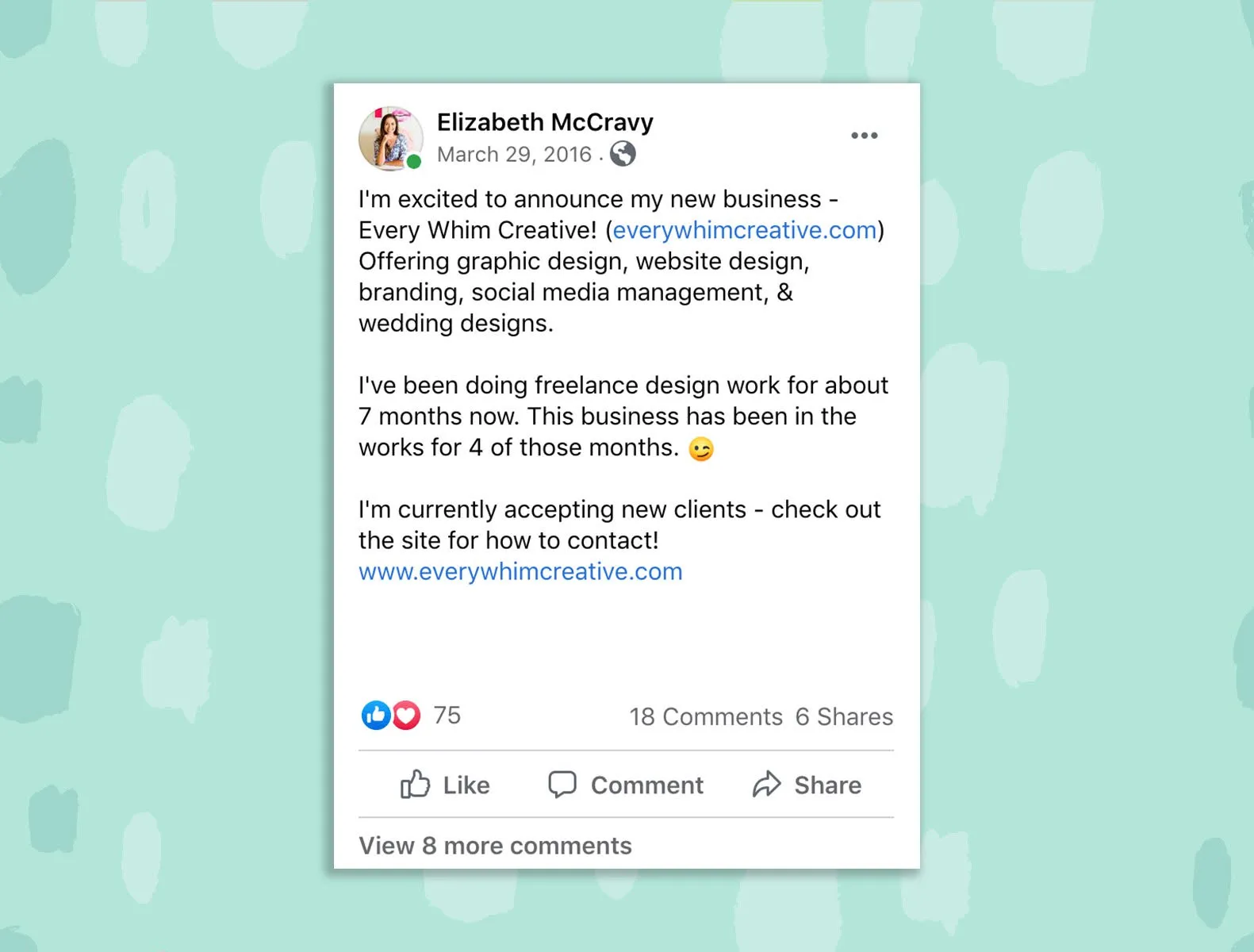
Back in 2016, I was 22 years old and just starting out. I had just launched my first website, which is kind of how I define when I officially started my business. I'd been freelancing for a while before that, but once I launched my website, I was taking on paying clients and starting to market myself on social media.
These seven things are what I wish I could go back and tell myself. I can't… so I'm here to tell you instead. These tips are especially relevant if you're new to business, thinking about starting a business, or still in that freelance side-hustle phase. Like I said, I was in that phase for about eight months before I officially launched my website and declared myself a business owner. But if you're farther along, these tips can apply to you too.
LISTEN TO THIS EPISODE NOW:
Subscribe & download the episode to your device: Apple Podcasts | Spotify | YouTube | iHeartRadio
Search for episode 332!
If you missed the first two episodes in this series, go back to episodes 330 and 331, where I share my biggest lessons from 10 years in business. This episode continues that conversation, but focuses more on lessons specific to that first year because a lot of the things that come up when you're new.
So, in no particular order, here are the things I wish I could go back and tell myself on day one.
1. You should have times in your business where growth is not a focus.
This is something I really wish I could tell myself on day one, because it often doesn't feel that way. We're told to have that hustle mentality or that you should always be growing. Whether that's financial growth or growth in followers and subscribers, the vibe in business is often that you should always be pushing forward.
But sometimes you need quarters, months, or seasons where one of two things is happening.
- You're stepping back because of life: maybe because of the birth of a baby, maternity leave, a death in the family, a move, a wedding, a big trip. There are so many times where you need space from your business and to shift into more of a maintenance mode.
- This is the one I feel like is less obvious but it’s when you're focused on fixing and improving internal, behind-the-scenes things in your business. This is a huge, not-flashy part of business that doesn't get talked about enough. When I think back over the last 10 years, I've spent so many weeks and months on projects that no one else saw. Nitty-gritty, often not-that-fun work that you just have to do to keep the business going like improving products, improving functionality, all of that.
Here are some specific examples from my own business.
One: changing project management systems. About five years ago, we switched from Basecamp to ClickUp. I now use ClickUp and Google Drive to run basically everything in my business and I love it. But that was a big project. I paid around $8,000 to the company that set it up. There were multiple calls, tons of forms to fill out, access to grant, things to approve along the way. It was expensive and time-consuming, and it wasn't a growth activity at all but it made the business better internally.
Two: rerecording course videos, or updating notes and materials in a course or other product. I've had to do that many times. It doesn't feel glamorous or like you're moving the needle, but it's really important.
Three: training a new team member and going through the hiring process in general. Whether you're bringing on a contractor or a W2 employee, that whole process (writing a job description, taking applications, interviewing, onboarding), is a lot of work. And again, it's one of those behind-the-scenes things that doesn't feel like growth, but absolutely is.
Four: redesigning my website is another great example. I've redesigned my own site a few times in the last 10 years, and it's a huge project. It can become more of an undertaking the longer you're in business. If you need help redesigning your website, make sure to shop my Showit templates here.
Other examples: learning about finances and changing how you manage your business's money, or taking a course on something. Watching a course, learning, and then updating your business based on what you learn takes you away from other work.
All that to say: business does not always need to be about creating new products, launches, sales, booking more clients, being booked out, and posting consistently on Instagram or TikTok.
Sometimes you have to step away and focus differently. And what I've found is it really helps when you clearly define that you're in that season and that your capacity is different right now. Like saying, "Hey, right now I'm focused on moving my business from Basecamp to ClickUp. That takes X hours a week, which takes me away from these other things, and that's my focus this Q1." Or defining, "I'm on maternity leave, and here's what that means for how many hours I'm working."
I wish I could go back and tell myself this because it was easy to feel like I was messing up by not focusing on growth when I was actually doing all those behind-the-scenes things I just described which are so important to running your business. They're just not flashy, and they're not creating new sales at that moment.
Read more: From Burnt Out to Booked Out: 4 Keys to Building an In-Demand Design Business That Won’t Drain You
2. Don't let lifestyle creep get you. Live within your means.
So many of you have probably heard the term lifestyle creep, but if you haven't, it's also known as lifestyle inflation: a phenomenon where your discretionary spending increases as you earn more money, causing former luxuries to become perceived necessities. It often subconsciously causes expenses to rise alongside income, preventing increased savings and hindering long-term financial goals like retirement.
Now, some lifestyle creep is normal as you get older and want nicer things. When I first started my business, I was young and had just moved to Nashville from a small town. I would order at restaurants based on literal dollar differences like this entrée is $12, this one's $11, I'll get the $11 one. I'm glad I don't have to do that anymore, and I'm grateful our budget isn't that tight now. But I also know how to be disciplined like that because I did it for years, early in my marriage and early in my business.
When I say lifestyle creep in the context of entrepreneurship, I mostly mean the big stuff. Like having a good year and buying a home or a car you can't really afford unless next year is just as good and then finding yourself in a situation where your business can't support your lifestyle anymore. It's stressful. You're burnt out, you're chasing money, and it's just not good.
Business can be so up and down — mine certainly has been. Don't let yourself be run into financial trouble because you inflated your spending to match a good year.
Honestly, I think not inflating our lifestyle is a big part of how we ended up with a rental property business with five properties. Instead of spending more, we focused on investing and living below our means.
Pay Attention To Your Business Money
I'd also add, and this could be its own separate point, pay attention to your business money. It's easy in entrepreneurship to let this slide. You didn't get into this because you wanted to be an accountant or bookkeeper. You got into it because you love your craft. So it can be hard to feel motivated to watch your money, budget well, spend well, and save well within your business.
Get a system that makes sense for your brain and how your business runs, and actually use it. Sometimes it takes a year or two of just going with the flow, seeing the gaps, and then building a system that works.
At first, I recommend trying things you learn from other business owners along the way. That's a great first step, but over time, ideally in that first one to three years, you want to figure out your system for knowing your numbers and managing the money. You'll adapt it as your business grows, but having something that works well for you matters. And I mean a system beyond just having a bookkeeper or accountant. I mean knowing your cash flow, spending, profit and loss within your own business.
I have a free guide called the End of the Month Financial Guide. It walks you through my seven-step money management routine for my business finances. I've done this exact system for about four years now, with variations before that. I also have podcast episodes where I talk about it, including how I use the Profit First system.

3. Sometimes you should just fire the client or not take them on in the first place.
This is something I learned the hard way. In the history of my business, I've had clients I should not have taken on at all. I've had to fire a client before. I've had situations where I knew in my gut something was off, but I didn't listen to that instinct because I was excited to work with them or flattered they wanted to work with me.
First, I want you to know: this happens. If it's happened to you, you are not alone. It's happened to me. It's happened to most business owners. And if it hasn't happened to you yet, it probably will, especially the longer you're in business. You will have some difficult client or customer situations that are taxing, that make you doubt yourself, that cost you time and money, and that can make you want to throw in the towel.
Don't be so shocked when it happens but also trust your gut and try to prevent it when you can. I have two older podcast episodes on this: episode 54, "How to Deal with Difficult and Angry Clients," and episode 55, "How to Prevent Difficult Client Situations." I never rerecorded those. I thought the originals were really good and left them as is. And if you're in Booked Out Designer, my course for designers, there are lessons on this too that go beyond what's on the podcast.
The biggest thing: I wish I could go back and tell myself to trust my gut with this stuff. It's hard, but you'll get through it, and it does not ruin or stop your business.
Read more: 4 Pieces of Advice I’d Give the Stay at Home Mom Starting a Part-Time Business
4. One bad review or angry person won't actually ruin your business the way it might feel like it will.
This one is so hard. When we talk about low points in business, I have genuinely been in situations where I felt like something was going to ruin everything, and it was sometimes just one negative review or one mean email. It's almost like you need 20 positive ones to make up for the one negative one. It can really derail your mood and your confidence in what you're doing.
Whether it's a negative review, someone talking badly about you online, a rude refund request, whatever it is, those things are just hard. And what I want to say to you, and what I would tell my new-business-owner self, is: you're going to be okay.
Slow down. Be slow to speak and quick to listen in those situations. Pause, pray, and talk to wise counsel. Because when someone is, say, bullying you online, and yes, that is a real thing that happens, your instinct might be to respond quickly and defend yourself. Don't. You don't have to respond to things immediately.
That's number four: one bad review or angry person won't actually ruin your business the way it might feel like it will.
5. Explore different methods for productivity, goals, and task management to find what works uniquely for you in your current life and business season.
This is a big one.
There are so many different apps, physical products, calendar systems, and productivity hacks out there that people can teach you. Things relating to goal setting, managing your to-do list, managing your calendar — all of that. My advice: try different things and find what works for you right now, then execute it.
The thing that works for you in one season may not work in another, and that's absolutely okay. It doesn't mean it was a bad system… it was the right system for then. Now you have another one, and then you'll try another, and it just changes as your life changes. And what works for someone you learn from on a podcast, in a course, or in a book may not truly work for you. You've got to forge your own path. It's helpful to hear what works for other people, but don't just carbon-copy their system and try to apply it to a life and business that might be very different from theirs.
When I think back on 10 years, I've had so many different systems for managing my to-dos, my launches, my schedule. They were all great. Honestly, if I were to start a different business, it might be around productivity, organization, and project management. I love all of it. But the systems I've used have changed a lot over the years, fitting certain seasons and not others.
What Doesn’t Work For Me Anymore
For example, longtime podcast listeners are going to know what I'm talking about, before having kids, I lived by putting every single thing on my calendar. I actually had an early podcast episode that went somewhat viral: episode 46, "How to Plan Your Entire Week on a Digital Calendar," from back in 2019. It's a really great episode and a really great system for when your calendar is more “your own.”
Now my life is different. I've spent about five years nursing and working around nap schedules for different kids, and I can't map out my whole day hour by hour the way I once did. It was a good system. It just doesn't work for my life anymore.
I've also had seasons where I managed my business goals using the 12 Week Year framework — if you've ever read that book, highly recommend it. I still follow it to some extent, just with less structure right now since I'm still kind of in maternity leave with my third baby.
I've used PowerSheets by Cultivate What Matters and the Full Focus Planner, which are both great tools. Right now I use the app Todoist a ton, for both business and personal life. I open it multiple times a day, on my phone and my laptop. On days when I'm with my kids and only have one work day a week, it helps me capture things as I think of them and then tackle them when I actually sit down to work.
All of that to say: don't expect the same system to work forever. Don't expect what worked for someone else to work the same for you. Be ready to adapt as your life and business change. And if you're a busy mom with little kids trying to do things the same way you did before you had them — stop. You're not failing. The system just doesn't fit your life anymore. I wish someone had told me that around year five, when I had my first child, instead of letting me feel like I was doing something wrong.
That's number five: explore different methods for productivity, find what works for your current season, and let it change and adapt over the years.
Read more: Daily Business Routines & Habits That Help Me Manage My Business Well as a Busy Mom

6. Invest time and effort into long-form content and SEO (search engine optimization).
I cannot overstate how important this one thing has been in my business over the last 10 years.
And I'd add: do this even when you're not sure the efforts will result in anything at all. Maybe they will, maybe they won't, but it's worth trying.
A lot of people in business are only interested in quick, provable wins, so they skip this stuff. Don't be someone who skips it. And yes, I mean even in the age of AI, even with how search is changing. I am so grateful I didn't skip this.
If you've been around here a while, you know I do a lot with affiliate marketing, meaning I promote other people's products, typically softwares that people use in their business, and earn a commission when someone buys through my link or code.
A lot of my affiliate marketing success now was set up years and years ago, and I'm still reaping the benefits. The foundation for some of these partnerships was literally laid in year one of my business. It took time to see results, but 10 years in, I'm so grateful I made those efforts and didn't listen to anyone who said it wasn't worth it.
And I want to say again: even with AI and search changing, I see results from long-form content — blogging, podcasting, YouTube — now more than ever, truly.
That's number six: invest time and effort into long-form content and SEO.
7. Do the unscalable things now, while you're small, instead of trying to do what people with big followings and big businesses are doing.
This is my favorite one, saved for last.
I beat this drum a lot on this podcast and in my courses. While you can do the unscalable, do it. Some of those things you won't be able to do forever, but do them now, while you're smaller and newer, as part of relationship building and foundation building, and to stand out.
Someone who is farther along with more customers, more clients, or a bigger team starts to be limited in what they can do — they have to focus on scalable things. You don't have that constraint yet. Use it.
Here are some very specific examples from my own business:
- Sending a physical card or gift in the mail to new customers or clients.
- Offering one-on-one time with you as a bonus, an upgrade, or something people can purchase — and I mean customers, not just clients. Can you offer one-on-one time to the people who buy your products?
- Giving your affiliates a prize just for sharing about your offer, even if they don't make any sales.
- Hopping on the phone for networking calls, or doing a discovery call for a product that nobody else would bother doing a discovery call for. I actually used to do 30-minute calls for people interested in buying my templates. If someone wasn't sure, I'd jump on with them and answer their questions.
- Sending a physically printed workbook to your students or clients. Someone buys a course or gets a bonus with another offer, and you mail them an actual printed workbook. I did this once for a Black Friday sale. I think the first 20 customers each got a launch guide workbook I had printed at FedEx.
- Sending a handwritten letter and branded stickers to every single customer. For many years after starting my template shop, I did this for every template customer. I'd go through new customers once a week, look up their name and email, find their Instagram or website, and write them a personalized letter and then tuck in the stickers and mail it from my home address. Eventually, to scale it up a little, I hired my mother-in-law to write the letters based on what I typed out for her. I'd put the customer's name, address, and my message into a spreadsheet, she'd work through them and mark them off, and I paid her per card.
But the point is: do the unscalable thing that people who are farther along simply can't do anymore. Think about what that could look like for you early in your business: things that build trust, build relationships, and leave a lasting impression. I still have such great memories of those discovery calls with template customers, of the one-on-one bonus calls, of all the physical things I've sent people in the mail over the years. I loved all of it.
And for those of you who are maybe 10 years into business like me: ask yourself what's something unscalable you used to do that you could bring back, to bring some joy back to your business and shake things up. I've been exploring that for myself, and honestly this whole list has been a good reference point for me too.

Going Back To Day One As a Business Owner
Okay, let me run back through these one more time. These are the things I wish I could go back and tell myself on day one as a business owner. And as I read through them, think about which one sticks out to you — which lesson do you need to hear right now?
- You should have times in your business where growth is not a focus
- Don't let lifestyle creep get you; live within your means.
- Sometimes you should just fire the client… trust your gut.
- One bad review or angry person won't actually ruin your business, even if it feels like it will right now.
- Explore different methods for productivity, goals, and task management to find what works uniquely for you in your current life and business season.
- Invest time and effort into long-form content and SEO.
- Do customer and client service things that are not scalable while you still can.
I hope you have a beautiful week, and I'll be back next week with another new episode.
Episodes mentioned:
Episode 54 on how to deal with difficult or angry clients
Episode 55 on preventing difficult client situations
Episode 46 on planning your week
Links Mentioned:
Grab my end of month financial guide (for free)
Not sure which template is right for you? Take the quiz!
Sign up for Podcast Success Blueprint
Listen to the Breakthrough Brand Podcast


